
The Jaguar Head in Huichol Culture: A Masterpiece of Traditional Beadwork
The people behind the beads
The artists who make these sculptures are Wixárika (plural Wixáritari), an Indigenous people of the Sierra Madre Occidental in west-central Mexico, with communities in Jalisco, Nayarit, Durango and Zacatecas. Their religious life centers on annual pilgrimages to Wirikuta, a desert they regard as the place where the world was created, and on the ceremonial use of hikuri (peyote), as described by Harvard Divinity School researcher Osiris González Romero.A younger tradition than it looks
Glass beads were not part of Wixárika art from the beginning. According to the Wixárika Research Center, historians say beads brought to Mexico in colonial times from what is now the Czech Republic took the place of shells, feathers and stones in traditional creations. The same source notes that in the 1970s the beadwork most commonly made was jewelry and small pieces. Only with time did designs grow more elaborate, until artisans were covering whole objects: masks, jaguar heads, decorated gourd bowls, eggs and more. That makes the beaded jaguar head a relatively recent form by the standards of Wixárika art, and a living one. Beadwork artist Herminio Ramírez Díaz, from San Andrés Cohamiata, describes the art as a process of continuous change, with today’s fine Czech beads adapted to carry Wixárika symbols onto jaguar heads, votive gourds and other figures. The Fowler Museum at UCLA makes a similar point, noting that Wixárika art, though rooted in tradition, is inherently contemporary.How a jaguar head is built
The method is simple to describe and punishing to carry out. Museum examples show the basic recipe: a carved wooden form or a gourd is covered in beeswax, and glass beads are pressed into the surface one at a time. The Penn Museum describes a Wixárika gourd mask with glass beads embedded in beeswax, and the Smithsonian notes that makers also use resin to hold the beads in place.- The form. The jaguar’s head is shaped first, with its brow, muzzle, ears and open jaw.
- The wax. A layer of beeswax, sometimes strengthened with resin, becomes the adhesive.
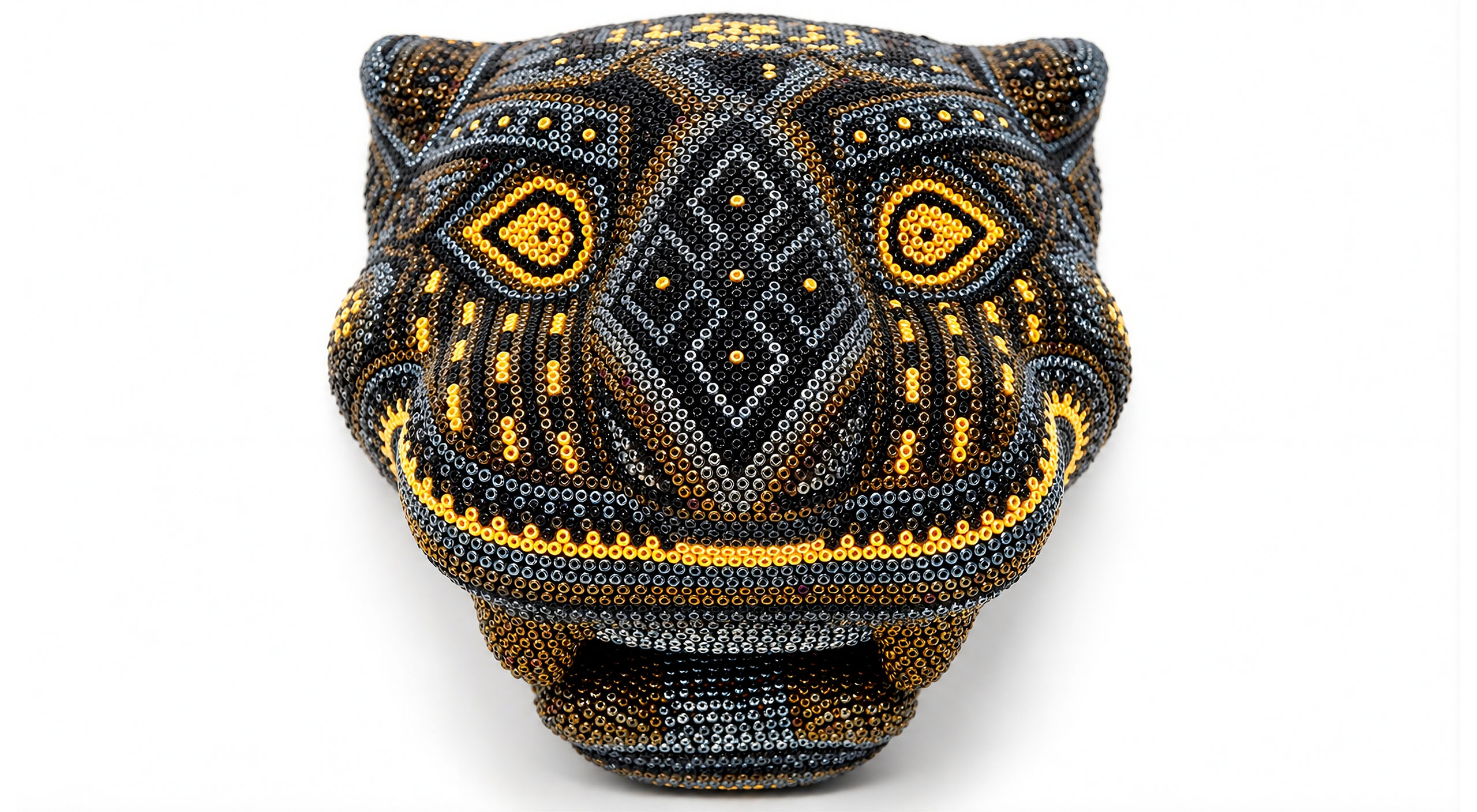
- The beads. Tiny glass seed beads are set singly, in rows that bend around the eyes, run down the bridge of the nose and follow the curve of the lips.
A bead is a small decision. A jaguar head is thousands of them, made one after another.
Reading the surface
Smithsonian writers describe Huichol beadwork as geometric patterns alongside depictions of animals and crops that carry spiritual significance. Some motifs are well documented. Ramírez explains that the deer is the main guide of knowledge, linked to hikuri, and that it appears in each of his pieces. The Folk Art Museum of Central Texas reads the deer and scorpion on its beaded jaguar as the spirit guide Kayumahli and a protector of peyote. The jaguar itself is harder to pin down. Sellers frequently describe it as a symbol of power, protection or leadership. We could not trace those meanings to scholarly or community sources, so they are best treated as popular interpretation. The diamonds and lattices on the head pictured here are geometric designs, and without the artist’s own explanation we will not attach a meaning to them.| Common claim | What sources support |
|---|---|
| Glass beadwork is ancient | Glass beads arrived through colonial-era trade and replaced earlier materials such as shells and stones. |
| Jaguar heads are age-old ritual objects | Sources describe them as part of beadwork’s later development into bead-covered objects. |
| The deer guides knowledge and links to hikuri | Stated by a Wixárika beadwork artist in a Cultural Survival profile. |
| The jaguar means power and protection | Widely repeated by sellers; not confirmed in the scholarly or community sources consulted. |
Why the jaguar head endures
Wixárika art has a long record of finding audiences beyond its home communities. Yarn paintings, for example, have drawn international acclaim since the 1960s. Beadwork followed a similar path, and for many families it is both a cultural practice and an income. Ramírez calls the craft vital for exactly that reason: it supports households while keeping artistic traditions alive. Popularity has a cost. The Wixárika Research Center reports concern over cultural appropriation, with designs borrowed and little credit or payment returning to the artists, and over cheaper imitations made elsewhere. That is one reason the maker’s name matters.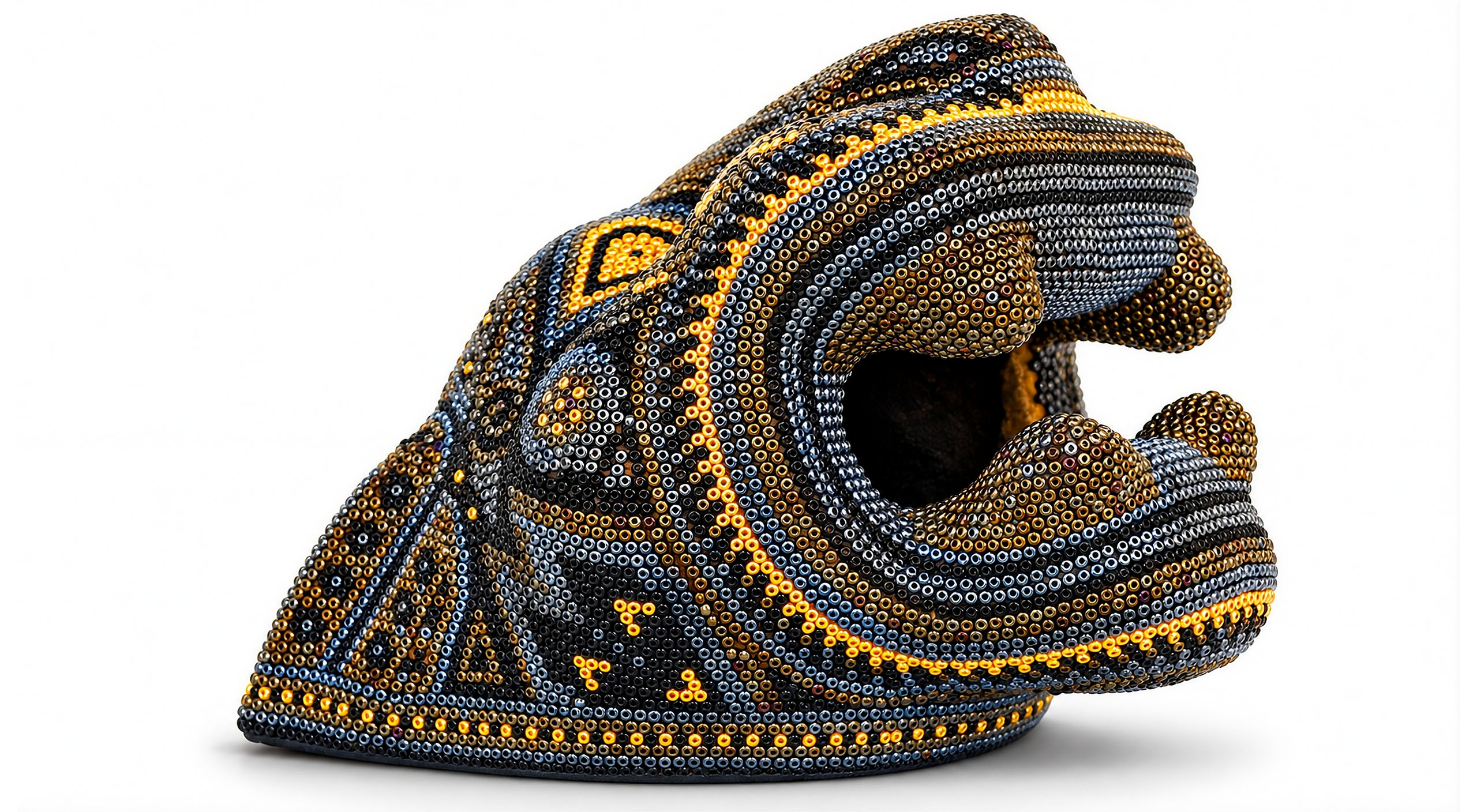
A piece to look at closely
A good jaguar head rewards slow looking. From across a room it reads as a sculpture with a strong silhouette. Up close it becomes pattern, rhythm and thousands of small choices of color. Understanding how it was made, and which of its stories are documented, makes it more interesting to live with, not less. If you would like to see more of this tradition, explore our collection of Huichol beadwork.Sources & Further Reading
- Beaded Art, Wixárika Research Center: history of bead use and the move to bead-covered objects.
- Painting with Beads: Herminio Ramírez Díaz, Cultural Survival: a Wixárika artist on symbolism and change.
- Meet the Vochol, Smithsonian Magazine: beadwork materials and the 2010 Vochol project.
- Transcendental Visions in Wixárika Art, The Nierika, Harvard Divinity School: Wirikuta, hikuri and visionary art.
- Huichol beaded gourd mask, Penn Museum: glass beads embedded in beeswax.
- Fowler Museum at UCLA exhibition release: Wixárika yarn paintings and international recognition.

Leave a Reply