✦ Free standard delivery on orders over $99
✦ Every piece handmade & authenticated
✦ From Zapopan to Calgary, shipped worldwide

Where every piece begins

The
Origins
of Craft

The
Origins
of Craft

From highland villages to desert workshops, every technique has a place, a people, and a story that stretches back centuries.

Craft doesn’t emerge
from nowhere — it emerges
from somewhere.

Origins is our map of that somewhere. It traces the routes between landscape and material, between ancient trade networks and living workshops, between the hands that shaped a tradition and the hands still carrying it forward today.

When you understand where a technique comes from, the object changes. It stops being décor and becomes evidence — of ingenuity, of patience, of an unbroken line of knowledge.

500+

Years of tradition

14

Regions mapped

38

Distinct techniques

60+

Artisan families

“Origins isn’t just provenance data. It’s the argument that knowing where something comes from is inseparable from knowing what it means.”

— Folk Art Mexico, on why origins matter

What origins covers

Three lenses on
craft history

Aerial view of Oaxacan valley showing terracotta earth, agave fields, and clay riverbed
01

Land & material

The minerals in Oaxacan clay, the copal trees that yield Alebrije wood, the cochineal insects that make carmine dye — geography is the first author of every craft.

Older man's hands guiding a young child's hands on a clay vessel in a Oaxacan workshop
02

Knowledge passed down

Most traditions we carry have no written manual. They live in demonstration, in watchful apprenticeship, in the correction of a parent’s hand on a child’s.

A pre-Columbian ceramic fragment displayed beside a contemporary Talavera piece on a stone surface
03

Time & transformation

Colonial trade altered dyes, pigments, and markets. Independence shifted patronage. Each era left its mark on form and symbol — and artisans absorbed it all.

What origins covers

Three lenses on
craft history

Pre-1500
Pre-Columbian roots
1500–1800
Colonial exchange
1800–1940
Independence era
1940–2000
Modernist revival
2000–now
Contemporary craft
Before contact · Pre-1500
The first language of material

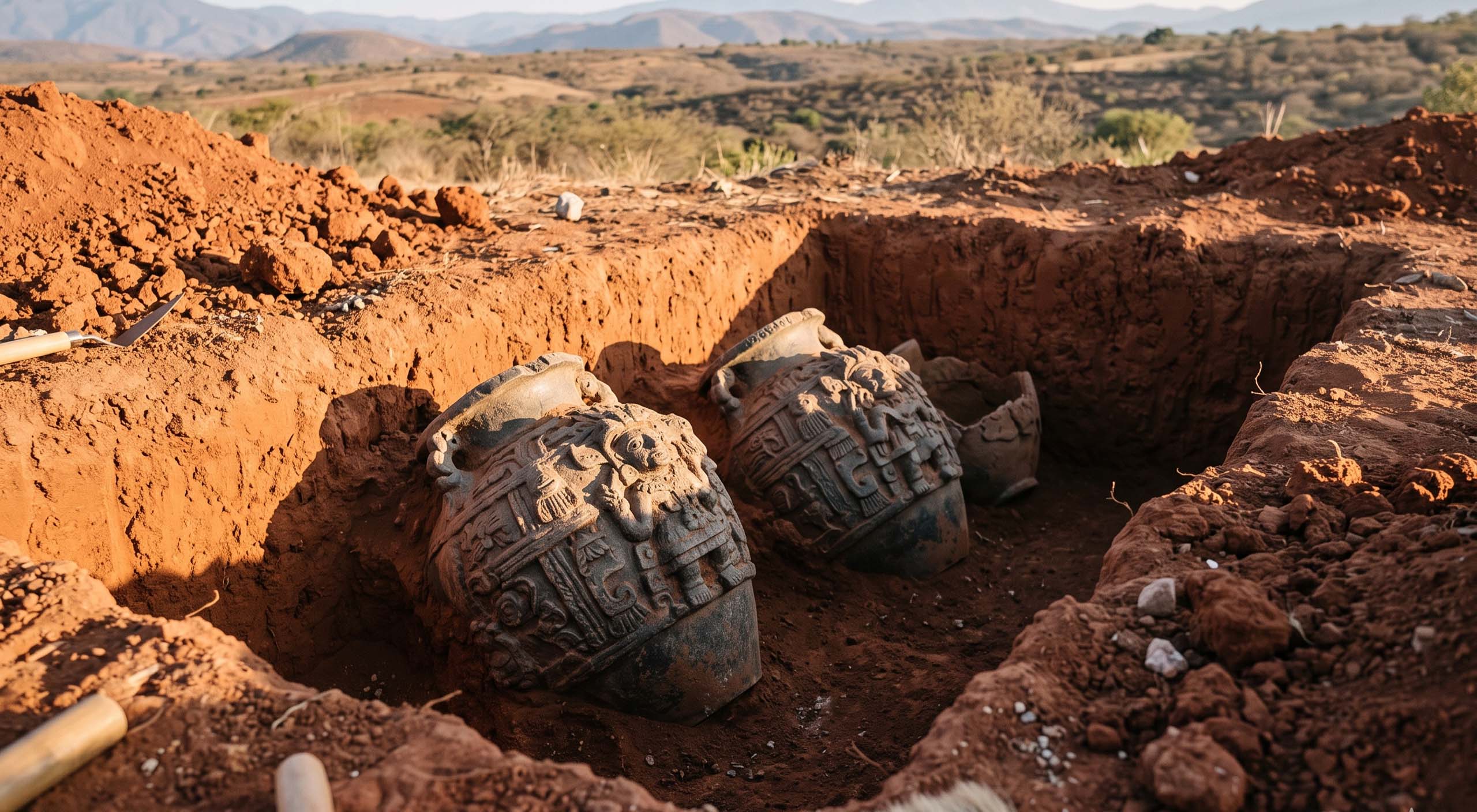
Long before European contact, Mesoamerican civilizations had developed sophisticated craft traditions tied directly to cosmology, ritual, and trade. The Zapotecs fired clay in open pits in the Oaxacan valleys. The Mixtecs inlaid turquoise and shell into wood and bone. The Aztecs wove cotton and featherwork of such complexity that Spanish chroniclers struggled to describe them.

Materials weren’t chosen for beauty alone — they carried meaning. Jade signified life and royalty. Obsidian, born of volcanic fire, held protective power. Cochineal red, harvested from insects feeding on nopal cactus, was so precious it functioned as currency along trade routes stretching from present-day New Mexico to Guatemala.
Zapotec ceramics Featherwork Jade carving Cochineal dye Obsidian tools

Techniques born in this era
Barro Negro clay
San Bartolo Coyotepec, Oaxaca. Burnished black earthenware fired in open pits — the same basic technique used for 2,000 years.
Natural dye weaving
Tehuantepec Isthmus. Backstrap-loom textiles dyed with cochineal, indigo, and marigold — a palette still used by Zapotec weavers today.
Copal incense carving
Oaxacan highlands. Sacred copal resin figures used in ritual — the same wood later carved into Alebrijes by Oaxacan families.
Huichol yarn painting
Nayarit highlands. Wixáritari shamans pressed dyed yarn into beeswax boards to map visions received in ceremony.
Pre-Columbian Zapotec ceramic urns in situ in an Oaxacan archaeological site
Oaxaca Valley · c. 500 BCE–1400 CE
Colonial period · 1500–1800
Collision, syncretism, and survival

Spanish colonization brought new materials, new markets, and new suppressions — but it did not erase Indigenous craft. Instead, a remarkable process of syncretism unfolded: Indigenous potters absorbed Moorish tin-glazing techniques from Talavera de la Reina; Franciscan friars commissioned altarpieces from Nahua carvers who embedded old cosmological symbols in Christian iconography; silk and imported pigments expanded the craftsperson’s palette while trade routes shifted.

The colonial workshop system, known as the obraje, forced many artisans into production lines — but also concentrated knowledge and allowed cross-cultural technique transfer at scale. The mestizo craft aesthetic that emerged from this pressure became distinctly Mexican: neither European nor pre-Columbian, but something that could only have been born from the collision of both.
Talavera majolica Lacquerware Tin-glazing Obraje workshops Religious syncretism

Techniques shaped by this era
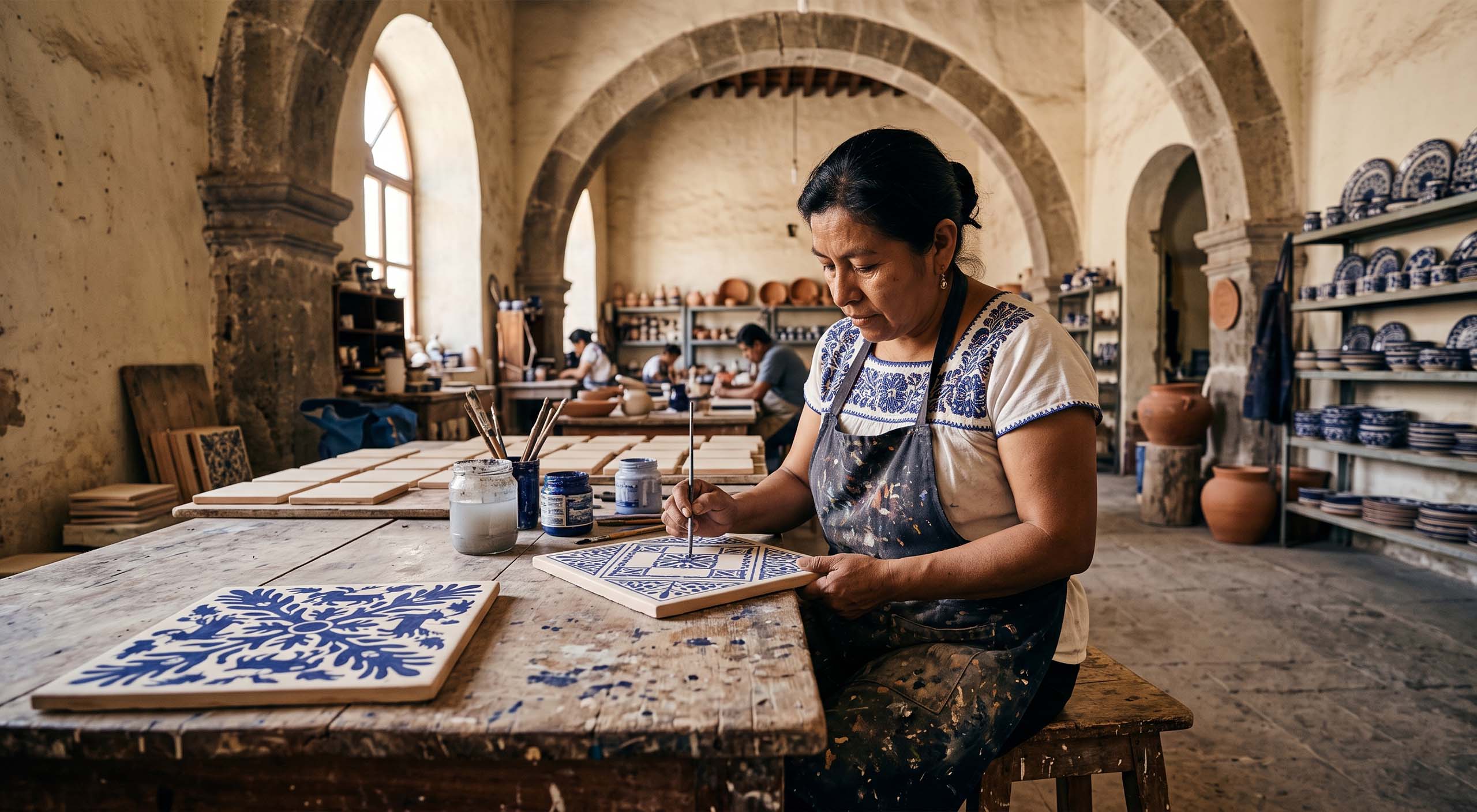
Talavera pottery
Puebla. Indigenous potters fused Spanish tin-glaze with Moorish geometric motifs and local clay — creating a uniquely Mexican form that carries UNESCO recognition today.
Lacquerware
Olinalá, Guerrero and Pátzcuaro, Michoacán. Pre-Columbian aje-oil lacquer techniques absorbed Asian influences via the Manila Galleon trade, producing the layered inlay work still made in these towns.
Papel picado
Puebla. Perforated paper traditions existed pre-contact; Spanish tissue paper and scissors transformed the medium into the festival decoration now inseparable from Mexican celebration.
Tinwork altarpieces
Mexico City and Oaxaca. Spanish tinsmithing collided with Indigenous metalwork sensibility, producing the devotional nicho and retablo frames still made by Oaxacan tinsmiths today.
Talavera tiles being painted in a colonial-era Puebla workshop, Spanish and Indigenous motifs side by side
Puebla · c. 1600–1750
Independence era · 1800–1940
Craft as national identity

Mexican independence in 1821 set off a long search for a national cultural identity that was neither Spanish colonial nor a romanticized pre-Columbian fantasy. Folk art became a political site. The 19th century saw the first systematic efforts to document, collect, and celebrate regional craft traditions as evidence of a distinctly Mexican civilization.

The Revolution of 1910 accelerated this project dramatically. Muralists like Diego Rivera and intellectuals like Dr. Atl argued that the true art of Mexico lived not in academies but in village workshops. The government began supporting artisan cooperatives. Foreign artists — including D.H. Lawrence and Sergei Eisenstein — came to Mexico and found in its craft traditions a vitality they felt European modernism had lost. This international attention helped codify which techniques became “classic” Mexican folk art in the global imagination.
Post-revolution patronage Indigenismo movement Artisan cooperatives Diego Rivera collections Export craft markets

Techniques elevated by this era
Otomí textiles
Hidalgo. The Tenango embroidery tradition — animals and plants rendered in bold running stitch — was codified and widely commercialized in the post-Revolutionary period under cooperative structures.
Talavera revival
Puebla. The post-Revolution period saw a deliberate government-backed revival of Talavera as a symbol of mestizo identity, standardizing techniques and establishing the certification system that still governs genuine Talavera today.
Oaxacan rugs
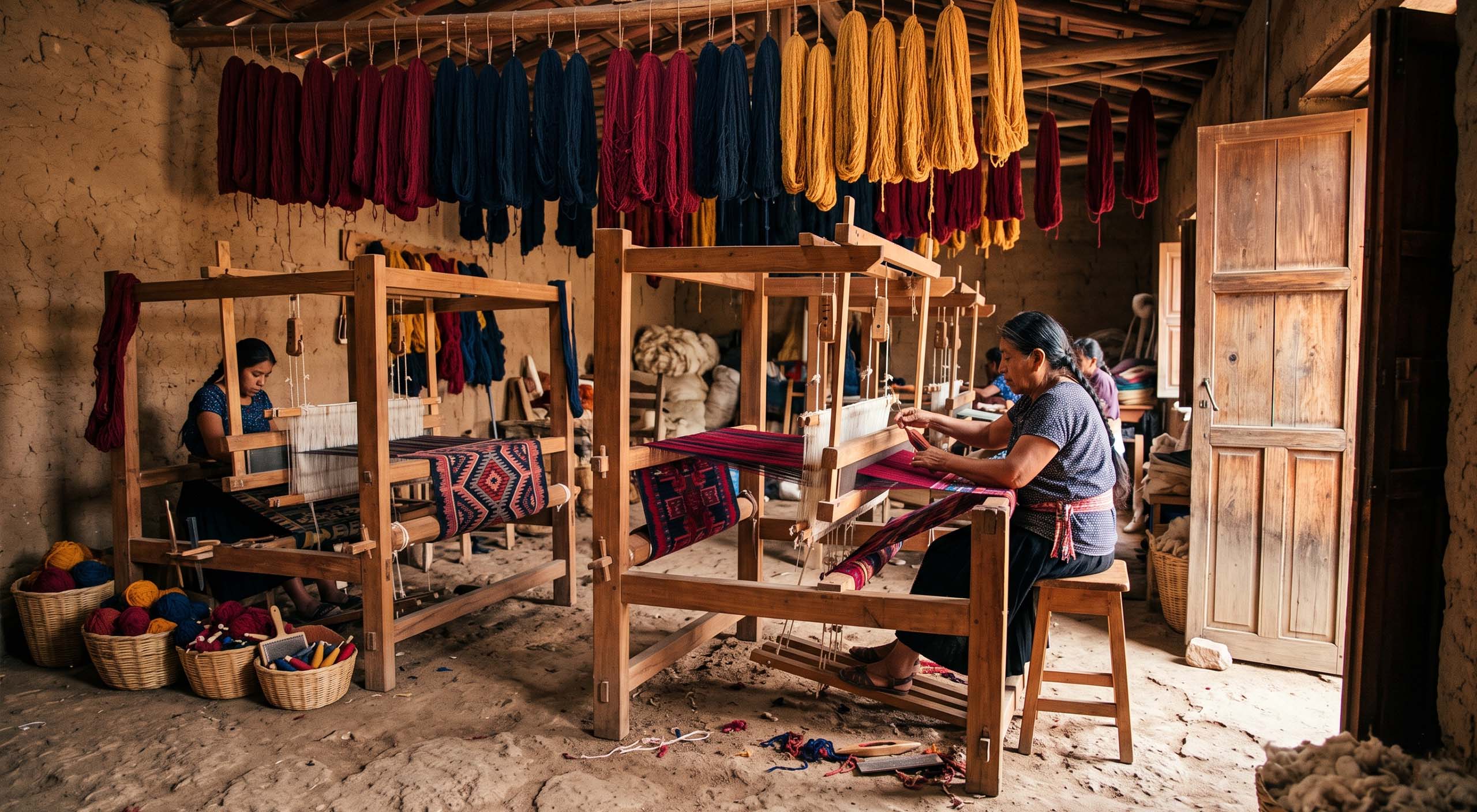
Teotitlán del Valle. Zapotec backstrap looms gave way to Spanish treadle looms in the colonial era; in the 1930s, weaving cooperatives in Teotitlán standardized the large-format wool rug as an export product.
Mask traditions
Guerrero and Michoacán. Dance masks used in religious festivals — part pre-Columbian, part colonial — were documented and collected during this era, entering museum collections and raising the form’s visibility globally.
1930s-style weaving cooperative interior — Zapotec weavers at treadle looms, natural-dye wool skeins overhead
Oaxaca · c. 1920–1940
Modernist revival · 1940–2000
Invention dressed as tradition

The second half of the 20th century produced some of Mexico’s most beloved craft traditions — and complicated the idea that “authentic” folk art must be ancient. Alebrijes, the fantastical painted wooden creatures now synonymous with Oaxacan craft, were invented in Mexico City in the 1930s by Pedro Linares, then adopted and transformed by Oaxacan woodcarvers in the 1980s. Mata Ortiz pottery was revived from archaeological shards by a single self-taught artist, Juan Quezada, in the 1970s.

This era also saw the institutionalization of craft. FONART, the national artisan fund, was founded in 1974. State craft museums opened across Mexico. Galleries in the United States and Europe began exhibiting Mexican folk art as fine art rather than ethnographic curiosity. Prices rose; quality differentiated; a market for “master artisan” work emerged alongside the tourist trade.
Alebrijes Mata Ortiz pottery FONART Gallery markets Master artisan tier

Techniques born or transformed in this era
Oaxacan Alebrijes
Valley of Oaxaca. Manuel Jiménez and the Linares family popularized copal-wood fantasy animals in the 1980s. What began as individual invention became a village-scale tradition within a single generation.
Mata Ortiz pottery
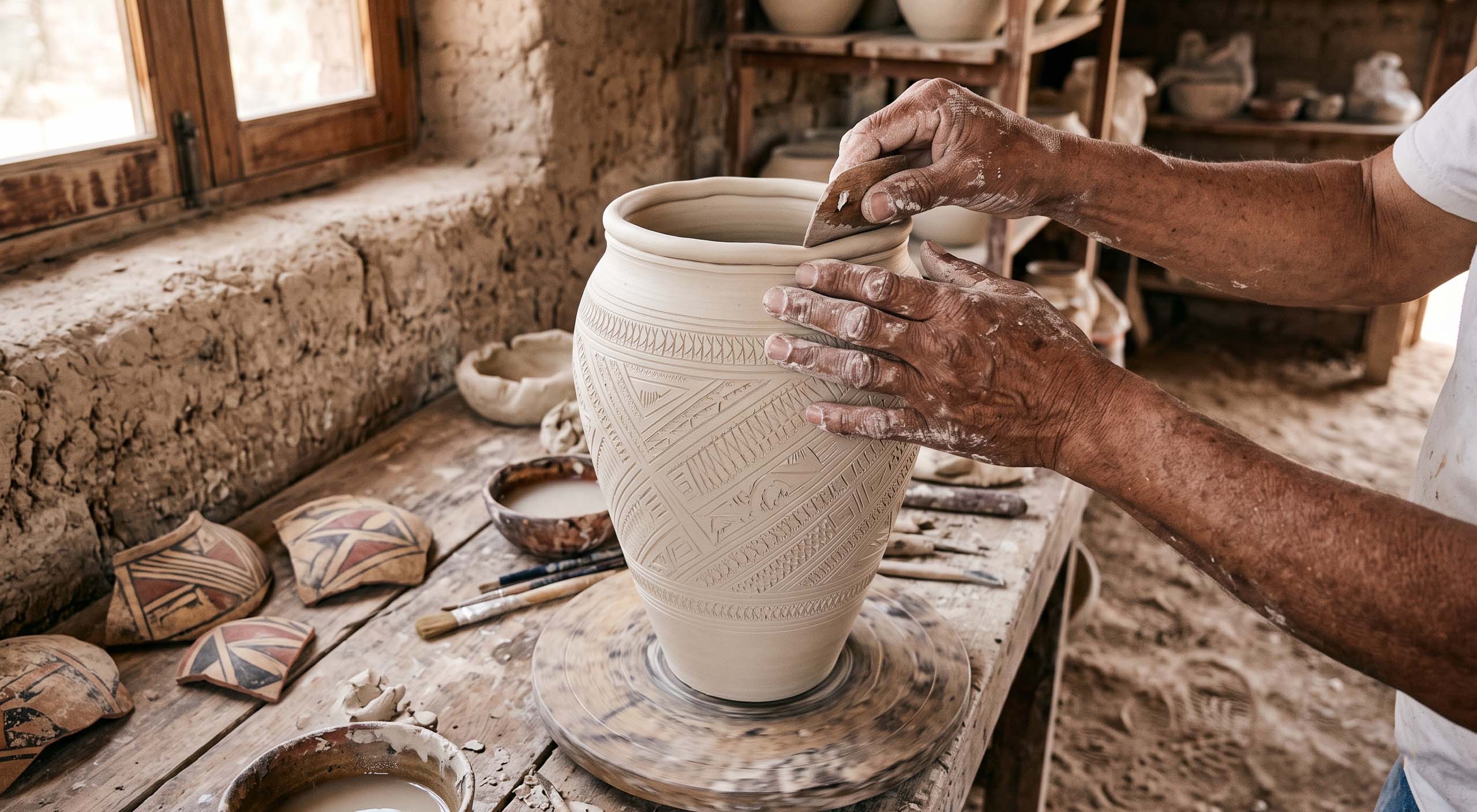
Chihuahua. Juan Quezada spent a decade reverse-engineering Casas Grandes ceramics from 700-year-old shards. By the 1990s, his village of Mata Ortiz had over 400 potters working in the revived tradition.
Blown glass
Tlaquepaque, Jalisco. European glassblowing arrived with colonization, but the mid-20th century Guadalajara design movement elevated Jalisco blown glass from utilitarian to collectible, expanding form and color vocabulary dramatically.
Huichol beadwork
Nayarit and Jalisco. The Wixáritari tradition of pressing glass beads into beeswax expanded from small ceremonial objects to large sculptural pieces as international art markets opened in the 1980s and 1990s.
Juan Quezada's hands shaping a Mata Ortiz vessel in a Chihuahuan desert workshop
Mata Ortiz, Chihuahua · c. 1975–1995
Contemporary craft · 2000–now
Keeping the knowledge alive

The 21st century has brought both threat and renewal to Mexican craft traditions. Migration of young people to cities and the United States has left some village workshops without apprentices. Fast-fashion imports undercut handwoven textiles on price. Machine-produced copies of Talavera and Alebrijes flood tourist markets, undermining authentic makers.

At the same time, a generation of artisans is pushing back with sophistication. UNESCO Intangible Cultural Heritage designations have been won for Talavera, Mariachi, and Día de los Muertos traditions. Young Wixáritari artists are showing beadwork in international galleries alongside contemporary art. Indigenous communities are using social media to connect directly with buyers who care about origin — and using that economic power to negotiate the terms on which their traditions enter the market.
UNESCO heritage Direct-to-collector Certification schemes Digital storytelling Artisan sovereignty

Traditions navigating this era
Certified Talavera
Puebla and Tlaxcala. The Regulatory Council of Talavera now certifies genuine pieces with a seal, protecting the 13 remaining authentic workshops against the estimated 90% of “Talavera” sold in Mexico that is mass-produced imitation.
Zapotec natural dye
Teotitlán del Valle. Young Zapotec weavers are reclaiming natural dye processes — cochineal, indigo, marigold — that were partly displaced by synthetic dyes in the late 20th century, driven by collector demand for authentic materials.
Contemporary Alebrijes
Oaxaca. Third-generation alebrije families like the Aguilars and Xuana are pushing the form into gallery-scale sculpture while teaching the next generation in family workshops, maintaining the oral transmission of technique.
Mata Ortiz expansion
Chihuahua. Mata Ortiz now has over 700 potters. The challenge has shifted from revival to quality stewardship — distinguishing master-level work from the flood of lesser pieces entering the same market under the same name.
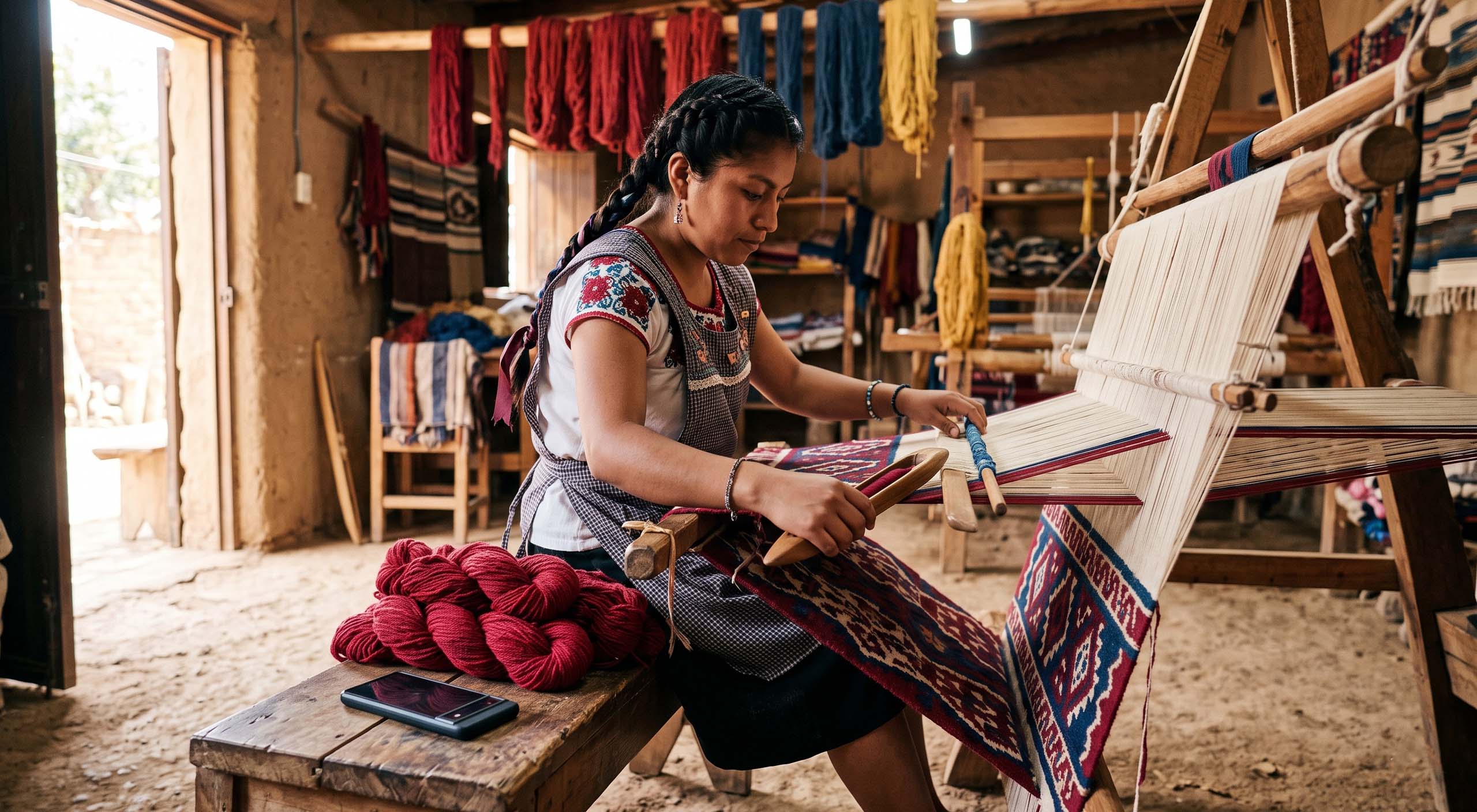
Young Zapotec weaver at a loom in Teotitlán del Valle, smartphone resting beside natural-dye skeins
Teotitlán del Valle, Oaxaca · 2020s

Key techniques

A glossary of craft origins
Barro Negro black clay vessel icon

Barro Negro

Black clay fired in open pits, polished to a mirror finish with a quartz stone. Indigenous to San Bartolo Coyotepec, Oaxaca.
Talavera tile with geometric pattern icon

Talavera

Tin-glazed majolica with Moorish-Spanish origins, reinterpreted by Pueblan potters into a distinctly Mexican form over 400 years.

Huichol beadwork deer eye motif icon

Huichol Beadwork

Glass beads pressed into beeswax on wood, creating intricate cosmological patterns. Each design carries sacred Wixáritari meaning.
Mata Ortiz coiled pottery vessel with geometric surface pattern icon

Mata Ortiz

A modern tradition born in the 1970s when Juan Quezada revived ancient Casas Grandes pottery techniques from archaeological shards.

“Every crack in a Barro Negro bowl, every motif woven into an Otomí textile — these are not decorations. They are records.

Folk Art Mexico — Origins

Continue exploring

Origins connects to

Artisan hands cradling a finished Alebrije figure in a dim Oaxacan workshop
People

Meet the Artisans

The families who carry these traditions in their hands, their workshops, their lineage.

Mexico relief map detail showing the Sierra Madre mountains and valley regions
Place

Explore Regions

Fourteen distinct regions, each with its own landscape, material culture, and craft identity.

Open field notebook with handwritten notes and a small ceramic shard, on a worn workshop table
Narrative

Read the Stories

Field dispatches, artisan profiles, and deep-dives into craft history from our sourcing trips.