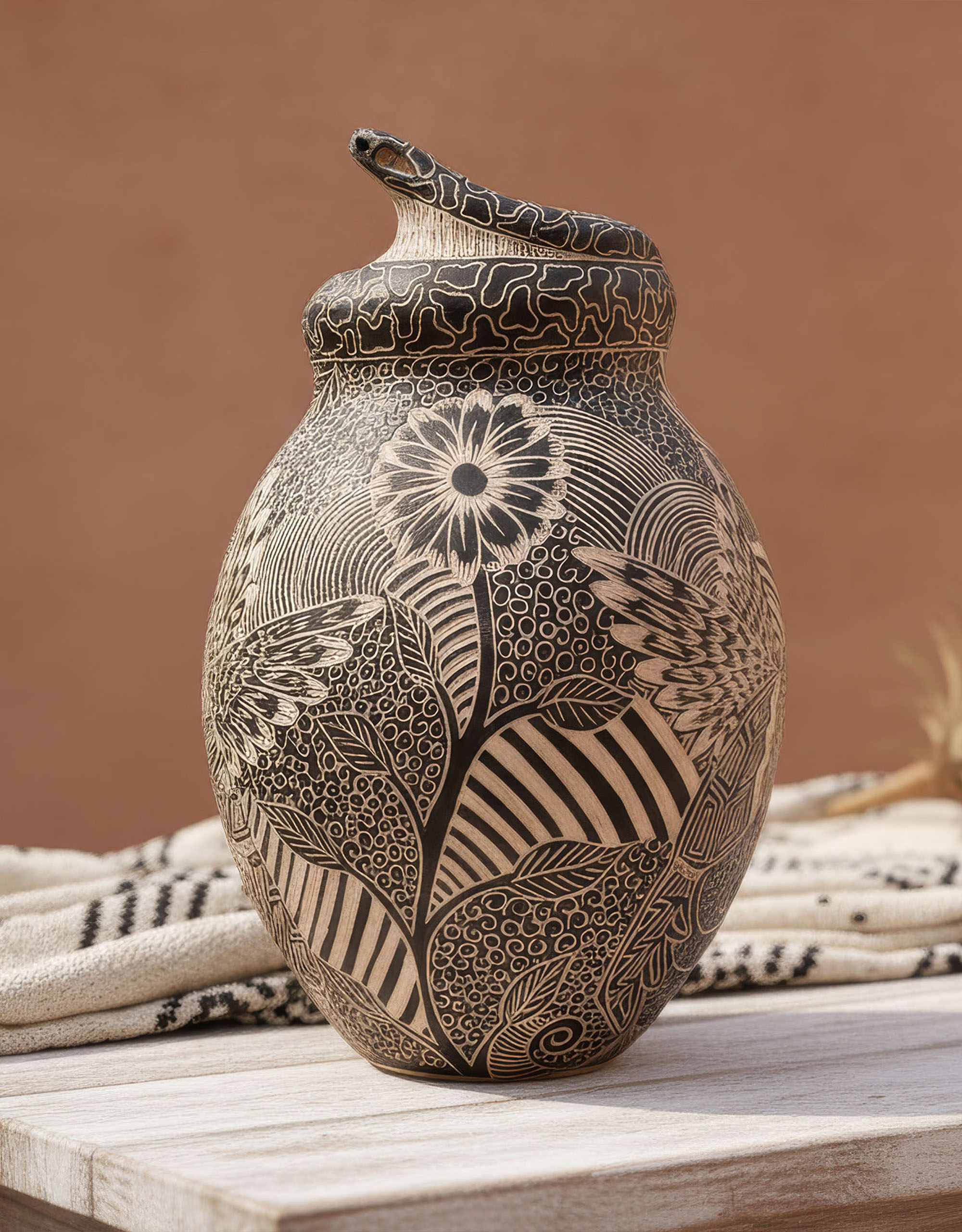
A Snake on the Hunt and a Hummingbird β Mata Ortiz Sgraffito Vessel by Alex Jurado
Product Details
A masterwork of obsessive detail and primal storytelling, this large Mata Ortiz olla by award-winning artist Alex Jurado transforms raw Chihuahuan clay into a living tableau. A coiled serpent crowns the vessel’s neck β mid-hunt, electric with tension β while a hummingbird moves unseen through a lush garden of blooms, spirals, and ancient geometric patterns. Hand-built, hand-burnished, and etched entirely by hand using the sgraffito technique, this is a piece that rewards years of looking.
Composition & Care
Size & Dimensions
Delivery & Returns
Description:
There is a moment in the high desert of northern Chihuahua, Mexico, just before a rattlesnake strikes, when everything goes still. The air tightens. The light changes. Time holds its breath.
That moment lives inside this pot.
Alex Jurado β one of the most celebrated and technically demanding artists working in the Mata Ortiz tradition today β spent weeks coaxing this vessel into existence. The clay was dug from the arroyos near the village of Juan Mata Ortiz, hand-formed without a wheel, dried slowly under the Chihuahuan sun, and burnished to a warm ivory satin before a single line was drawn.
Then came the sgraffito.
Working with tools no wider than a needle, Jurado painted the entire surface in deep black slip β and then carved it away, line by breathtaking line, to reveal the images beneath. This is not painting. This is excavation. Every curl of every spiral, every feather vein on every leaf, every scale on the serpent’s body was individually cut by hand. There are likely tens of thousands of individual marks on this single piece.
The Story in the Surface
The serpent that forms the vessel’s neck and spout is no decorative afterthought β it is the protagonist. Mouth slightly open, body tensed, it surveys a world of extraordinary botanical abundance below: great sunflower blooms with layered petals, tropical leaves rendered in graphic parallel hatching, and coiling tendrils that seem to breathe with organic life. Somewhere hidden in that garden moves the hummingbird β quick, jewel-like, oblivious to the predator above.
This is nature’s oldest drama: beauty and danger sharing the same world, inseparable, each making the other more vivid.
The background fills every space between the figurative elements with an astonishing variety of hand-carved textures β tight spirals that mimic rushing water, fish-scale arcs, Greek-key meanders, and cellular patterns that call to mind both microscope slides and pre-Columbian codices. Jurado draws from the full visual vocabulary of the Casas Grandes archaeological culture, the ancient civilization whose pottery inspired the Mata Ortiz renaissance, while asserting his own unmistakably contemporary vision.
The Mata Ortiz Legacy
The village of Juan Mata Ortiz had all but forgotten its ancient ceramic traditions until the 1970s, when self-taught potter Juan Quezada single-handedly revived them. Today, a community of several hundred artists β working entirely without wheels, kilns, or commercial glazes β produces what many collectors and museum curators consider the finest hand-built pottery being made anywhere in the world. Alex Jurado stands among the elite of this community. His work has earned recognition at juried fine art exhibitions across North America, and pieces from his studio are held in private collections from Calgary to New York to Tokyo.
Acquiring a Jurado sgraffito vessel at this scale and level of intricacy is not a casual purchase. It is an investment in one of the living masters of a tradition that has no parallel anywhere on earth.
Own the Stillness
Display this piece where light can move across it β morning light will catch the carved texture differently than evening light, and you will discover new details for years. On a pedestal in a living room, on a collector’s shelf, or as the anchor of a curated art space, it commands every room it enters.
The snake is still waiting. The hummingbird is still flying. The garden is still in full bloom.
They will be, for the next several hundred years.
Composition Hand-coiled and hand-built from locally sourced Chihuahuan desert clay. Surface burnished by hand to a natural satin finish. Decorated entirely using the sgraffito technique: black mineral slip applied and then carved away by hand using fine-tipped tools. Fired in a traditional outdoor pit or saggar kiln at low temperature, achieving the characteristic warm cream-and-charcoal palette. No wheel, no commercial glazes, no kiln machinery were used at any stage.
Dimensions Approximately 17 cm tall, 15 cm wide.


